


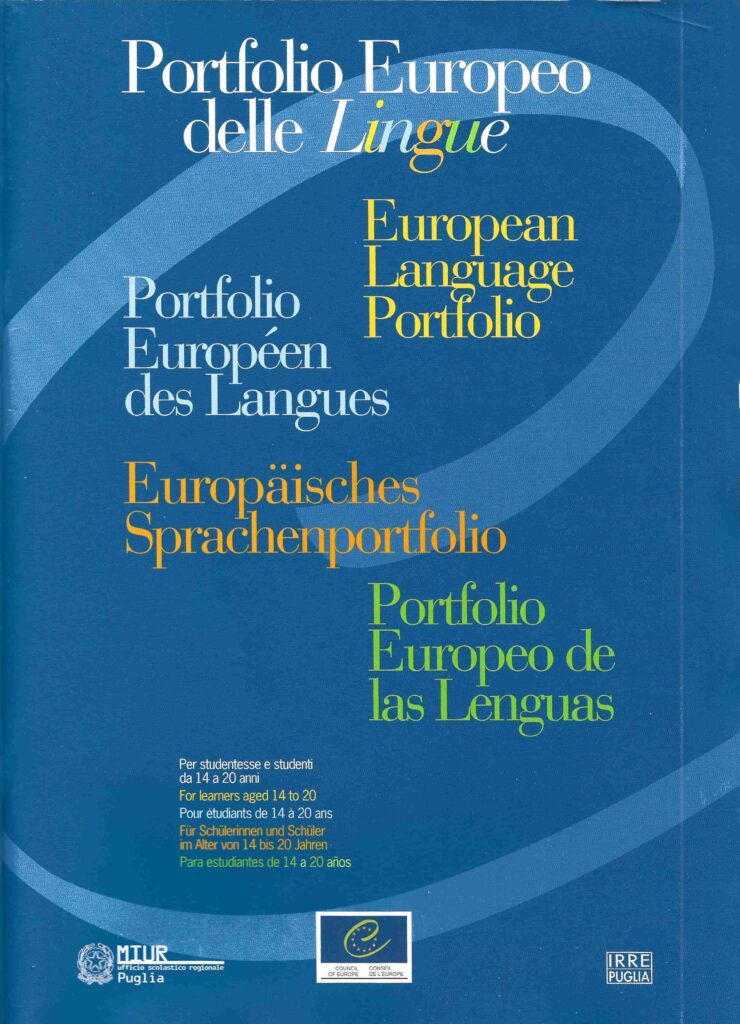
The European Language Portfolio (ELP)
Accredited Model No. 64.2004 | USR Puglia
Part 1: Overview of the ELP Model No. 64.2004
The European Language Portfolio, accredited model No. 64.2004, is a sophisticated pedagogical instrument developed for the Ufficio Scolastico Regionale per la Puglia under the aegis of the Ministero dell’Istruzione, dell’Università e della Ricerca. Published by Giuseppe Laterza & Sons Spa in 2004, this work represents a localized, high-standard implementation of the Council of Europe’s guidelines.
Unlike a standard textbook, this model is a multilingual developmental tool specifically engineered for students aged 14 to 20. This age bracket is critical, as it covers the transition from lower secondary school through the Liceo and into the early stages of university.
Most significantly, this portfolio was not designed for a single language, but as a plurilingual system encompassing five languages: Italian, English, French, German, and Spanish. By integrating these five languages into one accredited model, the project moved beyond “language learning” and toward “plurilingual competence,” encouraging students to see the connections between different linguistic systems.
The project’s academic rigour was ensured through the scientific consultancy of Peter Brown (EAQUALS President) and Frank Heyworth (EAQUALS Special Adviser), with the essential operational collaboration of the British School of Trieste and a dedicated team of experts.
Part 2: My own role and contribution
As one of the primary author of this accredited model, I occupied a pivotal role in the intersection of theory and practice. My contribution was essential in several key dimensions:
- Multilingual Architecture: Designing a portfolio that functions seamlessly across five different languages is a complex task. I helped create a standardized structure that allowed students to compare their proficiency in English, French, German, and Spanish against their native Italian, ensuring a balanced and cohesive approach to plurilingualism.
- Age-Appropriate Pedagogy: By targeting the 14-20 age group, My co-authors and I had to design “Can-Do” statements and reflection activities that resonated with adolescents and young adults. This required a sophisticated understanding of the cognitive and emotional development of students in this transitional phase of their lives.
- Institutional Standardization: As a co-author, I was responsible for ensuring that the model met the strict accreditation standards of the Ministry. I helped translate the high-level requirements of the CEFR into a practical manual that teachers across the Puglia region could implement consistently.
- International Calibration: Working alongside the EAQUALS consultants, I ensured that the Puglia model was not merely a regional document but an internationally valid instrument, aligning local educational practices with global quality benchmarks.
Part 3: Comprehensive Review of the ELP (Model 64.2004)
Bibliographic Summary
- Accreditation: Model No. 64.2004
- Institutional Body: USR Puglia / Ministero dell’Istruzione
- Target Audience: Students aged 14–20
- Scope: Plurilingual (Italian, English, French, German, Spanish)
- Consultancy: EAQUALS & British School of Trieste
- Publisher: Giuseppe Laterza & Sons Spa (Roma-Bari)
- ISBN: 88-421-0806-5
Critical Analysis
1. The Philosophy of Plurilingualism The standout achievement of Model 64.2004 is its commitment to plurilingualism. By covering five languages, the portfolio discourages the “compartmentalization” of languages. Instead, it encourages the 14-to-20-year-old student to develop a global linguistic identity. It acknowledges that learning Spanish helps one understand French, and that English proficiency is bolstered by an understanding of German structures, all anchored by the student’s native Italian.
2. Developmental Precision (The 14-20 Window) The choice of the 14-20 age range is masterful. This is the period when students shift from rote learning to critical thinking. The portfolio leverages this by focusing on metacognition—asking the student not just “What do you know?” but “How do you learn?” and “How do you feel about your progress?” This transforms the portfolio into a tool for personal growth and psychological maturity.
3. Structural Sophistication The model maintains a rigorous three-part structure, adapted for a multilingual context:
- The Language Passport: A streamlined snapshot of the student’s levels across all five languages.
- The Language Biography: A reflective space where the student documents their journey through the five languages, noting the challenges and triumphs of each.
- The Dossier: A curated collection of evidence (multilingual projects, essays, and recordings) that provides tangible proof of competence.
4. Synergy of Expertise The collaboration between the Ufficio Scolastico Regionale, the British School of Trieste, and EAQUALS created a “perfect storm” of educational quality. The result is a document that possesses both the administrative authority of the Italian state and the pedagogical flexibility of international language teaching.
Final Verdict
The ELP Model 64.2004 is a landmark in the modernization of the Italian educational landscape. It successfully shifted the paradigm from a “teacher-led” assessment to a “student-led” journey of discovery.
By integrating five languages and targeting the formative years of 14 to 20, the authors created more than just a record of grades; they created a roadmap for European citizenship. It remains a gold standard for how regional educational authorities can implement international frameworks (CEFR) to foster a generation of polyglots who are confident, self-aware, and culturally agile.